Our Advanced Carbon Oxide Sequestration is the most cost-effective, industrially efficient, and replicable way to maximize agricultural yields and soil productivity.
“Thinking about ways to increase soil carbon storage is a really important weapon in the arsenal,” said Ben Taylor, an ecosystem ecologist and Ph.D. candidate in Columbia University’s Department of Ecology, Evolution and Environmental Biology. “The carbon in soils is greater than all the carbon in our biomass and the atmosphere combined, so even small changes in that pool are going to have really large effects for us. If we can figure out how to manage that soil carbon pool size, it could be really effective.”
Cho, R. F. (2019, February 6). Can soil help combat climate change? State of the Planet. Retrieved June 5, 2022, from https://news.climate.columbia.edu/2018/02/21/can-soil-help-combat-climate-change/
“
The Earth’s soils contain about 2,500 gigatons of carbon—that’s more than three times the amount of carbon in the atmosphere and four times the amount stored in all living plants and animals. Currently, soils remove about 25 percent of the world’s fossil fuel emissions each year.
“
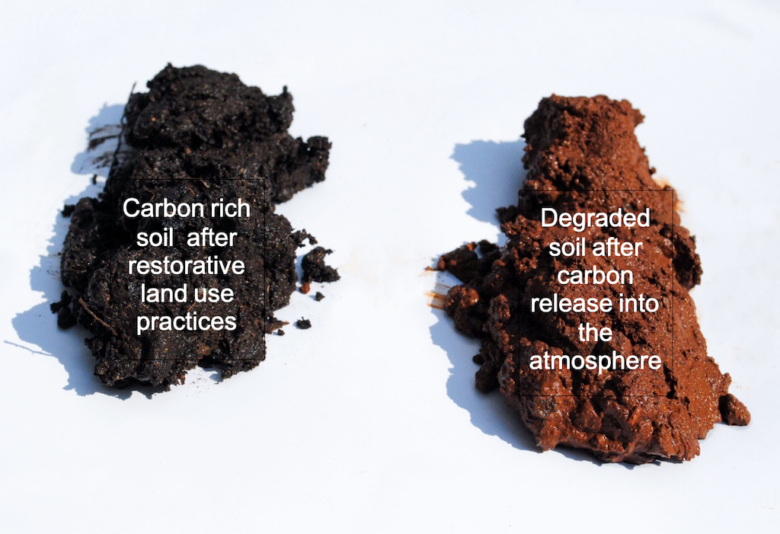
Capturing carbon in soil is a natural way of removing carbon dioxide from the atmosphere with fewer impacts on land and water, less need for energy, and lower costs. Better land management and agricultural practices can and should be used to enhance the ability of soils to store carbon and help combat global warming.
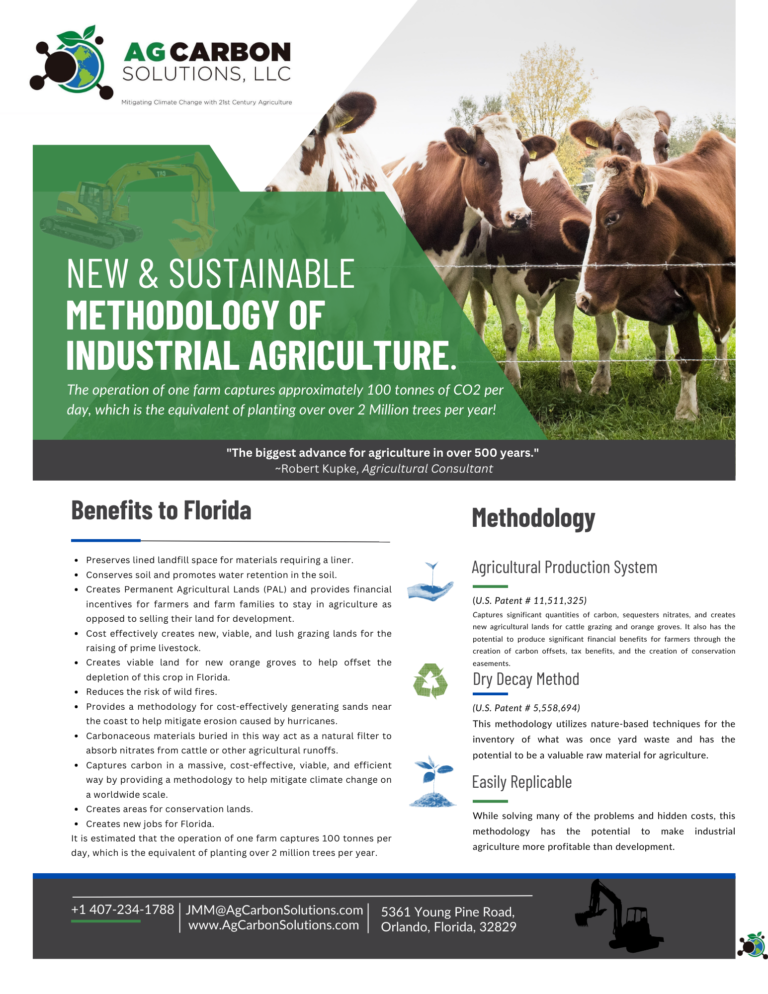
Each tonne (i.e. metric tons) of carbon captured by the Agricultural Production System (U.S. Patent # 11,511,325) is equivalent to the amount of carbon captured in a year by 80 trees.
It is estimated that the operation of one farm captures between 100 and 1,000 tonnes of carbon per day, which is the minimum equivalent of planting over 2 million trees per year!
Nature-Based Solutions (NBS)
This is by far the most cost-effective, efficient, and sustainable way to capture carbon (carbon dioxide from the atmosphere to carbon in the soil). These Nature-Based Solutions can be vastly replicated and expanded to absorb and secure carbon dioxide in the ground at a local, national, and global scale.
As seen in the Environmental Business Review Magazine